If your company operates a mobile crane with a rated capacity exceeding three tons in California, that crane must be inspected and certified annually by an accredited third-party certificating agency. The certification must result in a Plate V certificate per Title 8, Section 5021, and a copy of that certificate must be available with each crane or at the project site (Title 8, Section 5025). If you cannot produce a Plate V, the crane cannot legally be used.
This applies to all terrain cranes, rough terrain cranes, crawler cranes, hydraulic truck cranes, boom trucks, and any other mobile crane configuration exceeding the three-ton threshold. It does not matter whether the crane is owned, rented, or leased. If it is in lifting service in California, it must have a current Plate V.
A surprising number of crane owners and fleet operators are out of compliance and either don't know it or assume their internal maintenance program covers the requirement. It does not. Annual certification must come from an independent agency licensed under Title 8, Section 344.60. There is no self-certification path in California.
Proof Load Testing
Beyond the annual certification, Title 8, Section 5022 requires proof load testing at specific intervals.
New cranes must complete a quadrennial proof load test before initial use and every four years after. Previously uncertificated cranes already in service must be tested at the time of initial certification and every four years after that. If certificated equipment has been out of service for six months or more past its certification due date, a full examination equivalent to initial certification, including a proof load test, is required before the crane can re-enter service.
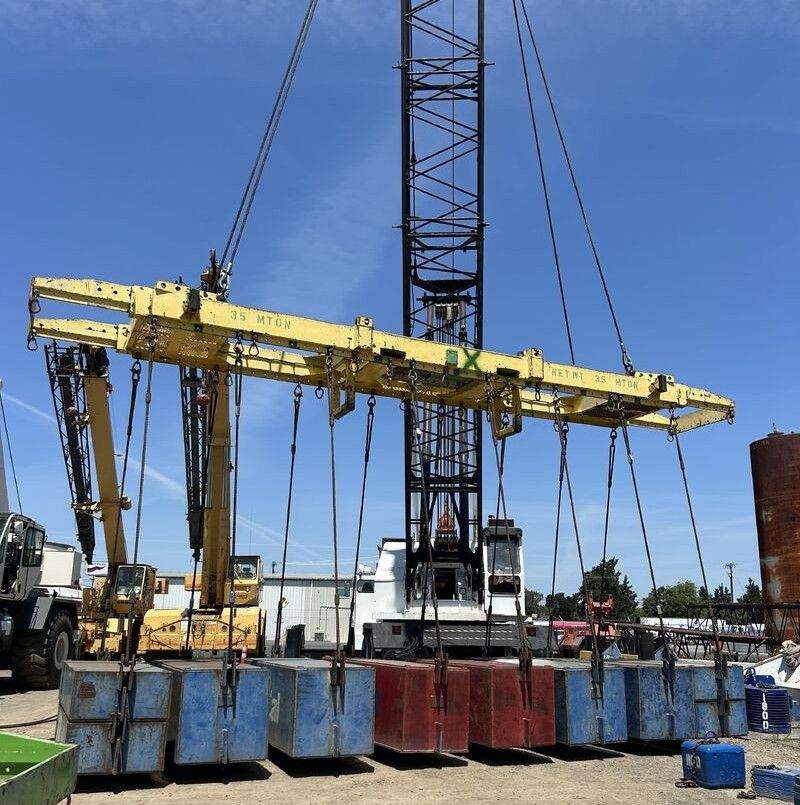
For mobile cranes, proof load tests must be conducted with the boom in the least stable direction relative to the mounting (Title 8, Section 5022(b)). The proof load must be based on the manufacturer's load ratings for the conditions of use and must not exceed 110 percent of the maximum load ratings for the boom on the crane (Title 8, Section 5022(c)). Proof loads must be applied at the designed maximum and minimum boom angles or radii, or as close to these as practicable, and the loaded crane must be swung as far as possible in both directions.
This is where mobile crane proof load testing becomes more complex than overhead crane testing. Overhead cranes traverse a fixed runway in a controlled environment and are tested at up to 125 percent of rated capacity. Mobile cranes are tested at up to 110 percent, but they operate at variable radii, boom angles, and configurations across changing jobsite conditions. The proof load test must account for the specific setup, and the surveyor must understand how the manufacturer's load chart applies to the test conditions.
One exception to note: cranes with a rated capacity greater than one ton but not exceeding three tons must undergo an initial proof load test before first use, but the recurring quadrennial proof load test is not required for this capacity range (Title 8, Section 5022, Exceptions to Subsection (a)).
What About Cranes Three Tons and Under?
Cranes three tons and under are not subject to the Plate V certification requirement under Section 5021. However, they are not exempt from inspection entirely. Federal OSHA standard 29 CFR 1910.180 applies to all crawler, locomotive, and truck cranes in general industry regardless of capacity, requiring both frequent and periodic inspections. In construction, 29 CFR 1926 Subpart CC covers all power-operated equipment used for hoisting.
Frequent inspections cover daily to monthly intervals depending on usage. Periodic inspections are more comprehensive and are required at intervals ranging from one to twelve months depending on how hard the crane works (29 CFR 1910.180(d)).
Equipment in this capacity range tends to be the most neglected because the state does not mandate third-party certification. That does not make it safe. It makes it invisible to regulators until something goes wrong.
Shift Inspections: What California Requires Before Every Use
Title 8, Section 5031 requires a qualified person to visually inspect the crane's controls, rigging, and operating mechanism prior to the first operation on any work shift. This is not optional and it is not a suggestion. Any unsafe conditions disclosed by the inspection must be corrected promptly, and defective components that create an imminent safety hazard must be replaced, repaired, or adjusted before the crane is used.
Daily visual inspections must cover all functional mechanisms for excessive wear or maladjustment, all pressurized systems for leaks or deterioration, hooks for deformation, wire rope for visible damage, outriggers and stabilizers for proper function, tires and undercarriage components, safety devices and operational aids, and the crane's level within the tolerances specified by the manufacturer.
For construction operations, 29 CFR 1926 Subpart CC adds additional shift inspection requirements including verification of ground conditions, outrigger pad sizing, load moment indicator configuration for current boom length and radius, and confirmation that all safety devices are functioning correctly before the first pick of the day.
These are baseline requirements that apply to every operator, every shift, every crane. Most crane owners handle shift inspections internally, and for many, that is sufficient. But a growing number of general contractors and project owners are raising the bar.
Third-Party Daily Inspections on Construction Sites
While Cal/OSHA and federal OSHA establish the regulatory floor for shift inspections, many general contractors are now requiring independent third-party daily inspections as a condition of operating on their jobsites. This is not an OSHA mandate. It is a general contractor-driven standard, and it is becoming common practice on well-run construction projects across California.
The concept is straightforward. Before a crane picks its first load of the day, a qualified third-party surveyor conducts a documented walkdown of the equipment, verifies that the crane is in safe operating condition, and provides the site safety team with a completed daily inspection form. The site safety representative has the documentation they need to keep operations moving and compliant, and the general contractor has an independent record that the equipment on their project was inspected by someone other than the operator or the crane company.
This is not a replacement for the annual certification or the quadrennial proof load test. It sits alongside those requirements as an additional layer of accountability, driven by the reality that construction jobsites have the highest concentration of crane incidents and the most exposure to regulatory scrutiny and liability.
For crane owners and operators, a third-party daily inspection program eliminates questions about the condition of equipment on site. For general contractors and site safety managers, it creates a defensible record that goes beyond operator self-inspection. For everyone on the project, it means the equipment was looked at by someone whose only job that morning was to determine whether the crane was safe to operate.
AC3 provides third-party daily crane inspections for construction jobsites across California. Our Cal/OSHA approved surveyors conduct the walkdown, document it, and provide your site safety team with the inspection record they need to keep the day moving.
Who Can Perform What
Not every inspection requires a licensed certificating agency. Understanding where the line falls helps you stay compliant without overspending and helps you recognize where you may be falling short.
Shift inspections (before first use each work shift) are the responsibility of the crane operator or a qualified person, per Title 8, Section 5031. These are in-house checks covering functional mechanisms, controls, rigging, hooks, wire rope condition, safety devices, and level verification. They are required on every crane, every shift, regardless of capacity.
Frequent inspections (daily to monthly, depending on service classification) expand on the shift inspection with additional checks based on how hard the crane works. These are the operator's or a designated person's responsibility under both 29 CFR 1910.180 and ASME B30.5. Documentation is required for monthly inspections at minimum.
Periodic inspections (one to twelve month intervals, depending on service classification) require a more thorough examination by a qualified person. For cranes three tons and under, this can be done in-house if your organization has someone with the training and experience to qualify. Most organizations do not, which is where a third-party inspection provider adds value even when the law does not explicitly require one.
There is also a practical reason to use a third-party provider on equipment that does not require it by law. An inspection performed by an independent certificating agency carries more weight in any liability dispute than one performed internally. If a crane is involved in an incident and the only documentation you can produce is your own operator's checklist, the question becomes whether that inspection was truly objective. When a licensed third-party agency documents the condition of your equipment, that record stands on its own. Insurance carriers recognize the difference, and so do attorneys.
Annual certification (cranes over three tons only) must be performed by a Cal/OSHA approved surveyor employed by a licensed certificating agency, such as AC3, under Title 8, Section 5021. The resulting document is the Plate V certificate. No in-house option exists.
Quadrennial proof load test (cranes over three tons only) must be performed by a licensed certificating agency. Proof load applied at the manufacturer's load ratings for the conditions of use, not exceeding 110 percent for mobile cranes, with the boom in the least stable direction. No in-house option exists.
Mobile Cranes Move. Compliance Has to Follow.
Unlike overhead cranes bolted to a runway in a fixed facility, mobile cranes travel between jobsites, cross jurisdictions, and operate under different contractors with different safety requirements. A Plate V issued in Oakland is valid statewide, but the crane's compliance status has to be tracked regardless of where it goes.
This creates a unique challenge for fleet operators. Every crane in the fleet has its own certification anniversary date, its own quadrennial cycle, and its own inspection history. When cranes move between projects, documentation has to move with them. Section 5025 requires a copy of the current Plate V to be available with each crane or at the project site. If a Cal/OSHA inspector shows up and you cannot produce it, the crane gets shut down.
For companies running multiple mobile cranes across multiple jobsites, the certification tracking problem compounds quickly. One lapsed Plate V on a 40-crane fleet can shut down an entire project. The larger the fleet, the more critical it becomes to have a reliable system for tracking certification dates and scheduling inspections before they lapse.
How Service Classification Affects Frequency
Both OSHA 1910.180 and ASME B30.5 tie the required inspection frequency to how your crane actually operates.
A crane that sits idle most of the year and runs only a handful of times should be inspected before each use, with a full periodic inspection at minimum annually.
A crane running two to five lifts per hour at loads well below rated capacity requires monthly frequent inspections and annual periodic inspections.
A crane averaging five to ten lifts per hour at around fifty percent of rated capacity requires monthly frequent inspections and semi-annual periodic inspections.
A crane running ten to twenty lifts per hour near rated capacity requires weekly frequent inspections and semi-annual periodic inspections.
A crane running twenty or more lifts per hour at or near rated capacity requires daily frequent inspections and quarterly periodic inspections.
Many crane operators have never classified their equipment by service. If your crane runs harder than your inspection schedule accounts for, you may be in compliance on paper with your annual certification but under inspecting relative to how the equipment is actually being used.
Why It Matters Before It Has To
Wire rope degradation, hydraulic seal failures, structural fatigue in boom sections, and brake wear all develop gradually. Routine inspection catches these when they are maintenance items with lead time. Without one, they surface as equipment failures on the jobsite when production stops and liability starts.
Mobile cranes face additional exposure that fixed cranes do not. Repeated setup and teardown, road travel, varying ground conditions, and environmental exposure accelerate wear on components that a crane sitting in a controlled facility would never experience. The crane that passed its annual certification six months ago may not be in the same condition today if it has been running hard across multiple jobsites in that time.
If you are unsure whether your Plate V is current, if your crane falls in the one to three ton range and has not been looked at in over a year, if your operators are not performing and documenting shift inspections, or if your construction projects require third-party daily inspections and you need a qualified provider, now is the time to address it. Contact AC3 for more information on how we can help you determine where your equipment stands and what it needs to stay compliant, operational, and protected.
AC3 is a Cal/OSHA accredited third-party certificating agency (CA-231) performing inspections, certifications, proof load testing, and third-party daily inspections on all types of mobile, overhead, gantry, and specialty cranes throughout California. Contact us to schedule an inspection or learn about our programs.